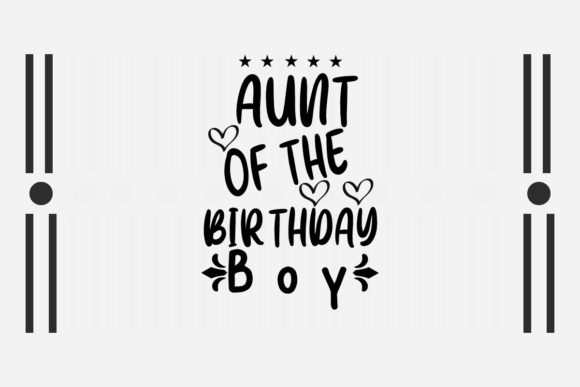
Reviewing the Aunt of the Birthday Boy SVG for Stitch Projects
As a designer who spends half my life digitizing files and the other half staring at hoop marks on my kitchen table, I approach every new Aunt of the Birthday Boy Svg with a mix of excitement and skepticism. We have all been there: you find a cute graphic online, it looks perfect on the screen, but the moment you try to stitch it out, the details vanish into a puddle of thread or the fabric puckers beyond recognition. Today, I am looking at this specific design not just as a digital asset, but as a potential centerpiece for real-world embroidery projects.
The premise is simple yet commercially potent. It is a funny quote design intended for t-shirts, posters, mugs, and more. But for us in the Crafts and Graphics space, the real question is always about translation. How does a vector file meant for print hold up when subjected to the physical constraints of needle and thread? Let’s break down what makes this design tick and where it might stumble if we are not careful.
First Impressions and Visual Personality
When I first opened the source file, which includes both EPS and SVG formats, the immediate impression was one of playful clarity. The design relies heavily on typography and character, which is typical for this niche. The mood is celebratory and slightly humorous, tapping into that specific family dynamic where the aunt is the "fun" relative. For an embroidery designer, this is good news. Designs with strong silhouettes and clear negative space tend to translate better to stitching than those with complex gradients or photo-realistic shading.
The layout feels balanced, suggesting it was created with versatility in mind. Whether you are placing it on the chest of a sweatshirt or centering it on a tote bag, the visual weight seems distributed evenly. This is crucial for custom apparel because unbalanced designs can cause garment distortion during the stitching process. The fact that it is described as "ready to print" and "color changeable" gives us a solid starting point, but remember: what works for inkjet printing does not always work for satin stitches.
Real-World Application: From Screen to Stitch
Let’s imagine a realistic scenario. You run a small shop on Etsy, and a customer orders a personalized gift for her sister’s son’s fifth birthday. She wants something durable, washable, and cute. A personalized gift like a high-quality cotton tote bag or a soft fleece blanket becomes the perfect canvas for the Aunt of the Birthday Boy Svg.
In this context, the design’s simplicity is its strength. If you are working with a machine embroidery design derived from this SVG, you will likely need to convert the solid shapes into fill stitches and the outlines into running or satin stitches. Because the design is vector-based, scaling is easy. However, you must be mindful of the stitch density. If you scale it down too small for a baby onesie, the text might become illegible. If you scale it up too large for a cap, the stitch count could become excessive, leading to long production times and potential fabric pull.
I recently tested a similar typographic design on a textured linen tote bag design. The result was charming, but only because I adjusted the underlay stitches to account for the weave. For this specific SVG, I would recommend testing it on a stable fabric first. If you are aiming for a sweatshirt embroidery look, the fuzzy texture of fleece can hide minor imperfections, making this a forgiving choice for beginners. However, for crisp embroidered patch work, you will need high-density stabilizer to keep those letter edges sharp.
Navigating Technical Challenges
While the design is versatile, there are areas where caution is required. The description mentions it is suitable for mugs and posters, which implies fine lines. In embroidery, fine lines are risky. If the original SVG has very thin strokes, they may disappear when converted to a running stitch or break frequently if attempted as a narrow satin stitch.
Here are a few specific situations where you should pause and evaluate:
- Small Hoop Sizes: If you are using a 4x4 inch hoop, ensure the text remains readable. Tiny lettering often merges together after washing.
- Stretchy Fabric: Knits and jerseys require careful stabilization. Without proper cut-away stabilizer, the weight of the design can cause the fabric to sag over time.
- Dark Fabric: The design is color-changeable, which is excellent. However, if you are stitching on black or navy, ensure your thread colors have enough contrast. A dark gray thread on a black shirt will render the Aunt of the Birthday Boy Svg invisible.
- Curved Surfaces: Applying this to a cap requires significant experience. The curvature can distort the text, so you may need to arch the design digitally before stitching.
Enhancing Product Value and Brand Consistency
For Etsy sellers and craft business owners, the perceived value of a product is tied to its finish. A well-executed embroidery project signals quality. When customers see clean thread trims, no puckering, and vibrant thread colors, they trust the brand. This design, with its clear theme, fits perfectly into the holiday embroidery or birthday niche, which is evergreen.
Using this SVG as a base for a digital embroidery file allows you to create multiple product variations. You can offer it as a baby embroidery item for infants, a teen apparel piece, or even home decor like a pillow cover. The key is consistency. If your brand is known for whimsical, family-oriented goods, this design aligns perfectly. It enhances buyer engagement because it tells a story—the story of the proud, fun-loving aunt.
Practical Designer Notes for Execution
Before you commit to selling finished items or listing this as a design assets package, take these practical steps:
- Test on Scrap Fabric: Never stitch directly on the final garment. Use the same type of fabric and stabilizer you plan to use for the client.
- Check Thread Contrast: Create mockups in black and white to ensure the design holds its shape without color reliance.
- Verify Licensing: The product description mentions it is a source file. Ensure you understand the commercial use rights. Can you sell the stitched item? Can you resell the digital file? Always clarify this before investing time.
- Inspect Small Details: Zoom in on the SVG. Are there any stray nodes or overlapping paths? Clean up the vector before converting it to an embroidery format to avoid machine errors.
- Consider the Wash Test: After stitching, wash the sample. Does the thread shrink? Does the fabric pucker? This determines if the finished product will survive real-life use.
In conclusion, the Aunt of the Birthday Boy Svg is a promising candidate for your next embroidery project. It offers the flexibility needed for various small shop product lines, from custom apparel to home goods. By respecting the technical limitations of embroidery and applying thoughtful digitizing practices, you can turn this simple graphic into a high-value, professional-grade item that customers will love to give and receive.